


The first recorded sounds, from 1860 - 17 years before Edison

While reading one of the stories in the Brilliant Void*, a friend of mine - a sound engineer as it happens, and apt to think about these things - came across this line:
'If science had only the means of conducting and reduplicating sounds, as it does rays of light, what carols of happiness would then have entranced my ears'
The story was written in 1858, a time when photography was well established (Louis Daguerre had released the first commercially viable photographic process in 1839) - but sound recording was in the future. And it struck us as odd when we thought about it that photography came so long before sound recording. And that sent us down a very interesting online Rabbit Hole.
If forced to guess I would have said that sound recording began in the very late 1800s with Edison's phonograph, and only really became established in the early 1900s. In terms of cultural impact, that wouldn't be far wrong - but it is a bit simplistic. Edison's breakthrough was not the recording of sound, but the ability to play it back. Sound recording had begun decades earlier, when the Phonautograph was invented by Édouard-Léon Scott de Martinville in France.
His machine is shown in the drawing above, and its not hard to see how that evolved with time into Edison's machine. But the crucial difference was that it was designed only to produce a visual image of the sounds recorded - not to play them back.
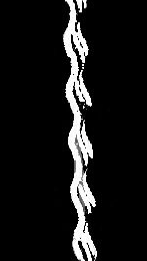
It used a horn to funnel sound toward a thin membrane, to which a stylus was attached that then scratched the vibrations onto a surface coated with soot, such as smoked paper or glass - creating images such as that shown here.
Apparently, Scott saw the device as an academic tool, allowing the study of sound waves and an examination of wavelength, frequency and amplitude. It never occurred to him that the recorded sounds could be replayed.
And it never occurred to anybody else either - until 2008, when The First Sound Project realised that there was enough information in the recording for it to be heard again with modern technology. And - thanks to their work - at this link you can hear the audio of Scott singing (or humming) Au Clair de Lune in 1860, along with other earlier recordings: FirstSounds.ORG.
This is 17 years before Edison famously recorded Mary Had a Little Lamb. Most of us will have heard that audio - but I only realised on reading about this today that the audio we have all heard is from much, much later: Edison re-recorded the nursery rhyme in 1927 for the 50th anniversary: the first recording has not survived.
The whole thing made me wonder how sound frequency was measured before this device was invented - which was a whole other rabbit hole: The History of Audio and Sound Measurement | Pro Audio Encyclopedia
*Brilliant Void: anthology of classic Irish Science Fiction - podcast coming soon!


Comments